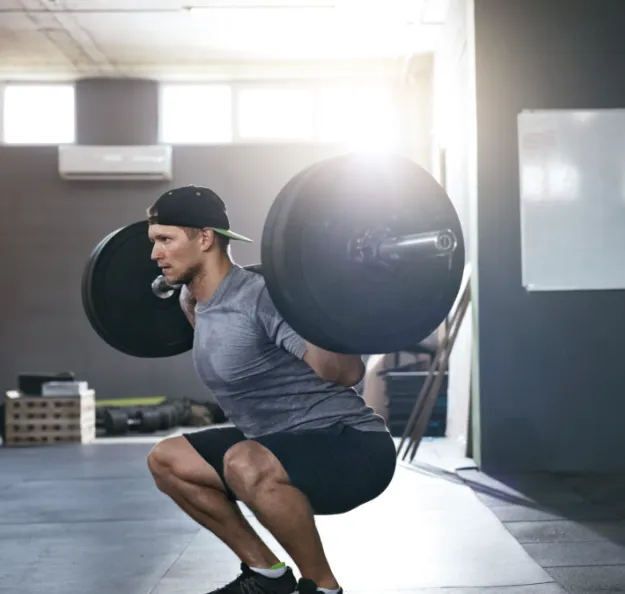
The squat is one of the best exercises you can do for building strength and power. However, improper form can lead to injury and prevent you from reaching your full potential. If you’ve been struggling to perform a solid squat or have hit a plateau, this post will guide you through the essential steps to improve your form and unlock your strength.
1. Mobility: Unlocking Your Range of Motion
Lack of mobility in your ankles, hips, or knees may be limiting your ability to squat with proper form and heavier weights. Our bodies send warning signals when we reach the end of a joint’s range of motion (ROM), often causing us to avoid loading that position under heavy weights. To squat properly and without pain, improving your mobility in these areas is key.
Ankle Mobility
Limited ankle dorsiflexion can prevent you from getting deep into a squat without lifting your heels. Try these strategies to improve your mobility:
- Banded ankle mobilization drills
- Foam roll and stretch your calves
- Wear lifting shoes with a slight heel elevation
- Stand on weight plates to elevate your heels
Knee Position
When squatting or lunging, your knees should track in line with your toes, ideally pushing outwards. This engages your glutes, providing more power and stability throughout the movement. Avoid letting your knees collapse inward. Practicing this knee position will also enhance your performance in exercises like deadlifts and Olympic lifts.
Hip Mobility
To squat effectively, your hips need to be both mobile and strong. Since many of us spend too much time sitting, hip mobility often suffers. Include these drills to improve your hip flexibility and strength:
- Banded hip mobilizations
- 90-90 hip stretches
- Goblet squat iso-holds
- Band walks for hip abductor strength
2. Core Bracing: Stabilizing Your Body
A strong, engaged core is essential when lifting heavy. If your core isn’t properly braced, your squat will be inefficient and risky. To develop core strength, practice activating your abs before each lift.
Some effective core exercises include:
- Deadbug and Paloff Press variations. These exercises teach you to engage your abs before lifting and improve your ability to brace properly.
To build a stable core, add direct abdominal work to your routine (aim for 3-5 times a week). Incorporate exercises that target all abdominal functions: flexion, extension, rotation, and anti-movements.
3. Glute Activation: Powering Your Squat
Your glutes are your body’s largest and most powerful muscle group, responsible for driving most compound movements like squats, deadlifts, and cleans. If your squats feel too quad-dominant, it’s likely your glutes aren’t firing effectively.
Activate your glutes before your main lifts with exercises such as:
- Mini-band lateral walks
- Banded glute bridges
Additionally, you can strengthen your glutes and posterior chain with accessory exercises like:
- Barbell hip thrusts
- Band or cable pull-throughs
- Back extensions
- Glute-ham raises
4. Dealing with Pain While Squatting
If you experience pain while squatting, first try adjusting your technique. However, if pain persists in your hips, knees, or back, there are a few ways to work around it until you can resolve the issue.
De-load the exercise: Sometimes, it’s necessary to reduce the weight. Lifting heavy with poor form can cause injury. Drop the weight to a manageable level, slow down your tempo, and focus on controlled, pain-free reps.
Regress the movement: If the traditional back squat doesn’t work for you, try variations that may be easier on your body. Front squats, box squats, goblet squats, or split squats can be great alternatives. Unilateral exercises can also help if you suspect muscle imbalances.
If it hurts, don’t do it: If no squat variation feels pain-free, consult with a physical therapist. In the meantime, you can work on leg strength with hip-hinging exercises like deadlifts, bridges, and isolation movements like leg curls and extensions.
5. How Strong Is Your Squat?
So, how do you know when you’ve built a strong squat? Comparing your lifts to standards based on bodyweight can help track progress. Here are general squat standards:
- Novice lifters: A good goal is to squat your bodyweight (your front squat will likely be 85% of your back squat).
- Intermediate lifters: Aim for 1.5 times your bodyweight for a back squat.
- Advanced lifters: For those with more than two years of training, squatting double your bodyweight is a significant milestone.
While not everyone will reach double bodyweight squats, hitting 1.5x bodyweight is already a strong indicator of lower body strength.
Conclusion
A strong, powerful squat requires more than just pushing weight around. It takes mobility, proper core bracing, glute activation, and technique to maximize your performance and avoid injury. By focusing on these foundational elements, you can build stronger legs that help you conquer physical challenges with confidence and efficiency.